Printing the Future: The Potential of Organ Bioprinting

Imagine a world where doctors no longer need to search desperately for an organ donor. Instead, they could print a new kidney using a patient’s own cells, ready for transplantation and perfectly matched to the body.
That idea might sound like science fiction, but researchers say it could become reality within the next decade.
Scientists in the field of regenerative medicine are developing 3D bioprinting, a technology that builds living tissues and organs layer by layer using living cells, specialized biomaterials, and advanced printers. Researchers like Jennifer Lewis at Wyss Institute for Biologically Inspired Engineering believe this technology could one day eliminate the organ donor shortage entirely.
And considering the current situation, that breakthrough can’t come soon enough.
The Organ Shortage Crisis
Right now, organ transplantation saves thousands of lives every year. But the supply of organs is far smaller than the demand.
In the United States alone, more than 100,000 people are currently waiting for a transplant, and every day about 17 people die before a matching organ becomes available. Kidneys are by far the most needed organ.
Even when a donor organ becomes available, there are still major challenges. The donor must be a good biological match, the organ must be transported quickly, and the patient’s immune system may still reject it.
Researchers see bioprinting as a potential solution to all of these problems.
Instead of waiting for a donor, doctors could create a custom organ using the patient’s own cells, dramatically reducing the risk of rejection.
How 3D Bioprinting Actually Works
The process starts surprisingly small.
Doctors take a tiny sample of tissue from the patient, sometimes smaller than half a postage stamp. From this sample, scientists isolate living cells and grow them in sterile incubators where they receive nutrients and oxygen, allowing them to multiply into millions of cells.
These cells are then mixed into something called bioink.
Bioink is a soft, gel-like material made from water-rich molecules called hydrogels along with growth factors and nutrients that keep the cells alive. Scientists sometimes describe it as a biological “glue” that holds the cells together, similar to the extracellular matrix that naturally supports cells inside the body.
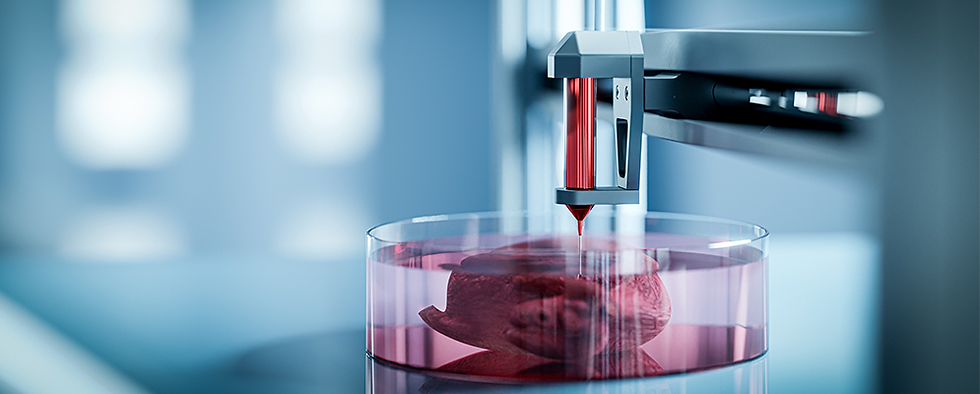
Once the bioink is prepared, it is loaded into a specialized 3D printer.
But instead of printing plastic or metal, the printer deposits living cells. Much like a regular printer uses multiple colored cartridges, bioprinters use different bioinks containing different cell types.
Guided by medical imaging scans such as CT or MRI data, the printer carefully builds the tissue layer by layer, recreating the structure of the organ.
Depending on the complexity, printing can take several hours. After printing, the developing organ is placed in a device called a bioreactor, which acts like an artificial body environment. Here, the tissue receives oxygen and nutrients while it continues to mature.
From the initial biopsy to a transplant-ready organ, the entire process may take four to six weeks.
The Hardest Problem: Blood Vessels
Printing cells is only part of the challenge. The real difficulty lies in something much smaller: blood vessels.
Every organ in the body depends on an incredibly complex network of vessels that deliver oxygen and nutrients. Cells must be extremely close to a blood supply to survive, sometimes within the width of a human hair.
This means that a printed organ needs thousands or even millions of tiny branching vessels to function properly.
Researchers at Stanford University recently developed a powerful algorithm that can design realistic vascular networks far faster than previous methods. The system can generate a complex “vascular tree” that mimics the branching patterns found in real organs.
In one example, scientists designed a model for a heart containing about one million blood vessels, something that would have taken months with earlier techniques.
While today’s printers cannot yet produce vessels that small, researchers have already demonstrated printed networks that can deliver oxygen and nutrients to living cells. In experiments, printed vascular channels successfully kept clusters of human kidney cells alive.
This progress is a critical step toward creating full, functioning organs.
Building an Organ That Truly Works
Even if scientists can print the correct structure, organs still need to function properly.
A heart must beat. A kidney must filter blood. A liver must process toxins.
Researchers are still working through these biological challenges. For example, printed blood vessels currently act as channels for fluid but do not yet contain all the specialized cell layers needed to behave like real arteries or capillaries.
But progress is accelerating. Scientists have already shown they can grow enough heart cells from stem cells to potentially print an entire heart. The next challenge is combining those cells with the vascular networks needed to keep them alive.
Step by step, the pieces of the puzzle are coming together.
Why This Could Change Medicine
The potential benefits of organ bioprinting are enormous.
If successful, it could mean:
No transplant waiting lists
No need for donor matching
Far lower risk of organ rejection
Personalized organs grown from a patient’s own cells
It could also reduce healthcare costs. For example, patients with end-stage kidney failure often require dialysis treatments that can cost hundreds of thousands of dollars per year and place enormous stress on the body.
A printed organ transplant could eventually become a far more effective long-term solution.

How Close Are We?
Despite rapid progress, fully functional printed organs are still under development.
Experts estimate that large, transplant-ready organs may still be a decade or more away. Scientists must continue improving printing precision, cell growth methods, and vascular systems before the technology is ready for widespread medical use.
But smaller printed tissues are already being used in research and drug testing today.
For many scientists in regenerative medicine, the goal is clear: a future where no patient dies waiting for an organ.
And if 3D bioprinting continues to advance the way it has over the past decade, that future may not be as far away as it once seemed.
To learn more, explore these links:


Comments