Alphafold and the Modeling of Protein Stucture

One of the biggest challenges in biology is understanding how molecules inside our cells interact. Proteins, DNA, RNA, and small molecules constantly bind together in incredibly precise ways, and those interactions control nearly every process in the body.
For decades, scientists have tried to map these structures experimentally using techniques like X-ray crystallography and cryo-electron microscopy. These methods are powerful but slow and expensive, sometimes taking years to determine the structure of a single protein.
Then came a major breakthrough: AlphaFold, an artificial intelligence system developed by DeepMind.
The earlier version, AlphaFold 2, stunned scientists by predicting protein structures with remarkable accuracy.
Now, the newest version, AlphaFold 3, goes even further. Instead of predicting the structure of individual proteins, it can model entire molecular interactions, including proteins, DNA, RNA, drugs, and other molecules all at once.
This dramatically expands what AI can do in biology.
Why Molecular Shape Matters
To understand why this is so important, imagine proteins as tiny machines.
Just like a key must fit into the correct lock, biological molecules must fit together with incredible precision to function properly. The exact 3-dimensional shape of a molecule determines what it can bind to and what it can do.
For example:
Enzymes bind specific molecules to catalyze chemical reactions
Antibodies recognize pathogens by binding to precise molecular shapes
Drugs work by fitting into specific pockets on proteins
If scientists know the exact shape of these molecules and how they interact, they can design better medicines and better understand disease.
But determining those shapes experimentally can take months or even years.
That’s where AlphaFold comes in.
What Made AlphaFold 2 Revolutionary
The earlier version, AlphaFold 2, used deep learning to predict how a protein’s chain of amino acids folds into a 3-D structure.
Think of a protein like a long string of beads that folds into a complex knot. Predicting that final shape from the sequence alone had been considered one of biology’s hardest problems.
AlphaFold 2 solved this challenge so well that it predicted structures for hundreds of millions of proteins, creating a massive public database used by researchers worldwide.
But it still had limitations.
Most biology doesn’t involve a single protein acting alone. Instead, molecules interact in complicated networks.
That’s what AlphaFold 3 was built to solve.
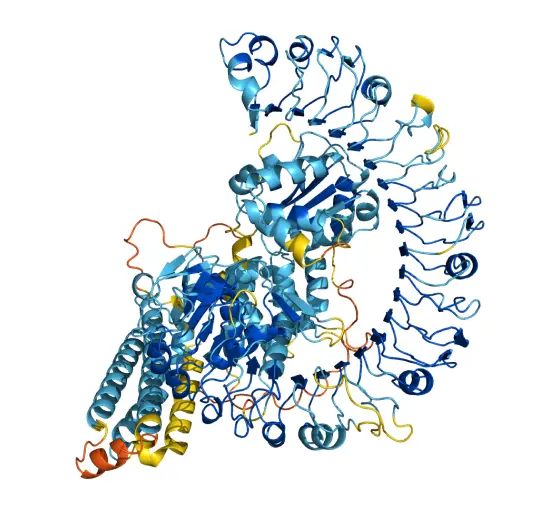

What AlphaFold 3 Can Do
AlphaFold 3 can predict structures for complex molecular systems, not just individual proteins.
It can model interactions between:
Proteins and other proteins
Proteins and DNA
Proteins and RNA
Proteins and drug-like molecules
Antibodies and viruses
In other words, it predicts how the entire molecular puzzle fits together.
This is extremely important for drug discovery. Many medicines work by binding to a specific protein, and understanding that interaction precisely is critical for designing effective drugs.
In benchmark tests, AlphaFold 3 was significantly more accurate than traditional computational methods used to predict how drugs bind to proteins.
The New Technology Behind It
One of the biggest innovations in AlphaFold 3 is a new type of AI architecture called a diffusion model.
A helpful analogy is restoring a blurry photograph.
The AI starts with a random cloud of atoms, almost like static noise. Then, step by step, it removes the noise and refines the structure until a realistic molecular shape emerges.
At each step, the model improves its understanding of how atoms should be arranged.
This process allows the system to learn molecular structure at multiple scales, from tiny chemical bonds to the overall shape of large biological complexes.
It’s similar to the type of diffusion models used in modern AI image generation, but applied to biology instead of pictures.

Why This Matters for Medicine
Understanding molecular interactions is one of the foundations of drug discovery.
Pharmaceutical researchers spend years trying to determine how potential drugs interact with target proteins. If scientists can predict these interactions accurately with AI, it could dramatically accelerate the development of new treatments.
AlphaFold 3 is already showing impressive performance in predicting protein–drug interactions, which are essential for designing new medicines.
It is also particularly strong at modeling antibody interactions, which are critical for developing vaccines and immune therapies.
By predicting these structures quickly, researchers can test many more ideas before moving to expensive laboratory experiments.
To Learn More, Explore these links:


Comments